
Why do so many AI implementations fail to deliver results?
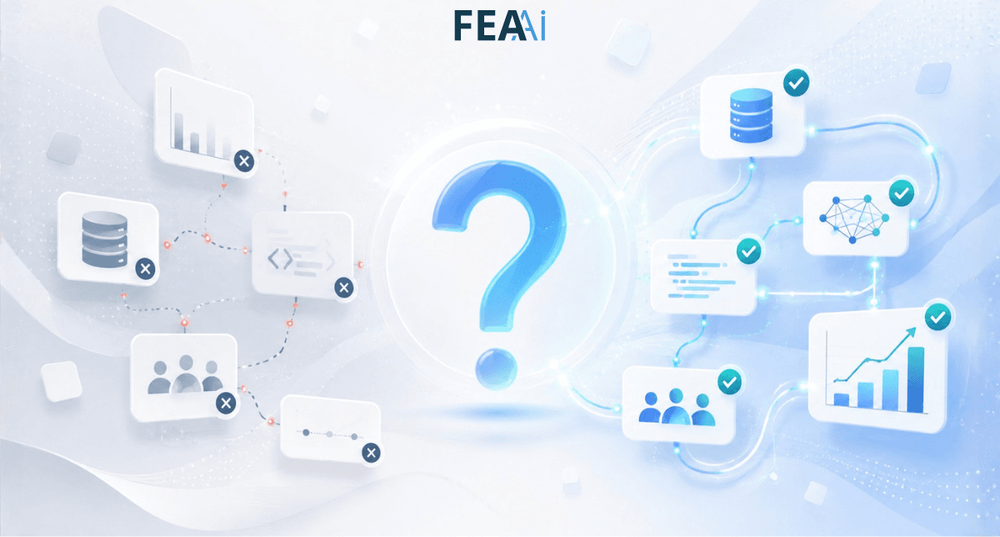
Many AI initiatives look promising in pilot projects but fail to create measurable business value once introduced into everyday operations. The problem is often not the technology itself, but weak integration with business processes, limited management support, fragmented ownership, and low organizational adoption. Off-the-shelf solutions can add further complexity when they do not reflect how the company actually works.
Artificial intelligence is now present in almost every area of business. Companies use it to automate repetitive tasks, analyze data, generate forecasts, and support management decisions. In theory, all of this promises faster operations, fewer errors, and more accurate, data-driven decision-making. In practice, however, AI often fails to deliver the expected business impact.
AI does not automatically become a business advantage
In practice, many organizations are disappointed by the results. AI projects are launched, impressive demos are created, and pilot solutions are tested, yet the benefits often fail to show up in business performance indicators.
The reason is rarely the technology itself. The problem is more often that the technology is not integrated organically into the way the company operates, while AI integration into business processes remains partial or isolated. As a result, companies end up with solutions that may be technologically impressive but do not reflect their actual workflows or decision-making logic.
This raises an important question: how can AI-supported custom software be integrated into business processes safely, thoughtfully, and in a way that creates measurable business value?
Without management support, AI initiatives stall
One of the most common barriers is a lack of commitment from senior management. Without a clear strategic direction, AI initiatives can easily lose momentum and become side projects alongside day-to-day operations. In these cases, it is often unclear which business problem AI is supposed to solve or how success should be measured.
Adequate resources may also be missing, decisions take too long, and projects become stuck in the experimental phase. AI can only become a genuine organizational capability when management does more than approve its use and actively guides the integration of artificial intelligence into business systems.
Without this support, AI is unlikely to become properly embedded in everyday operations or generate sustainable business value.
When AI becomes just another isolated solution
AI can affect several areas of a business at the same time, including daily operations, customer experience, and risk management. Yet these areas often work independently, pursuing their own objectives with minimal coordination. As a result, each team may expect something different from AI and use it in a different way.
If an AI solution is designed and introduced by a single team, other stakeholders can easily be left out of the decision-making process. The consequences quickly become visible: misunderstandings emerge, parallel or even conflicting solutions are developed, and implementation becomes slower and more difficult.
AI can create real value when different business areas shape the solution together and when it is designed not to serve isolated interests, but to become fully integrated into complex enterprise processes.
The role of corporate culture in AI success
Many employees are uncertain about the growing role of AI. Common questions include how automation will affect their responsibilities, what changes it will bring to their everyday work, and how new tools should be used effectively. This caution is usually not deliberate resistance. It often stems from limited practical experience and uncertainty about the role AI is expected to play in daily tasks.
If an organization does not address these concerns deliberately, AI solutions can easily remain underused. Employees return to familiar working methods, and organizational change encounters resistance.
Companies are more likely to succeed when they support learning, create room for experimentation, and communicate openly and clearly about the role AI will play in the organization's future. Corporate culture has a major influence on whether AI genuinely becomes part of everyday operations or remains a technology imposed on the organization from the outside.
Overly generic off-the-shelf software
Many companies begin their AI journey with pre-packaged, off-the-shelf software. At first glance, these solutions may seem fast and cost-effective. However, they often include functionality that does not match the organization's actual way of working and therefore creates little practical value in everyday processes.
At the same time, fitting them to critical business workflows often requires compromises, resulting in more complicated operations and unnecessary complexity.
By contrast, AI-supported software tailored to business processes is built around the company's own workflows. Instead of following generic logic, it works with the organization's existing data, operational patterns, and decision-making situations.
AI therefore does not become simply another layer added to the technology stack. It becomes a practical tool that supports data-driven decision-making, reduces manual work, and helps continuously optimize daily operations.
The advantage of custom software development is that the resulting system can provide exactly the functionality the organization needs while remaining scalable enough to grow alongside the business. This is what separates overloaded off-the-shelf products from purpose-built, AI-supported solutions.
What does AI success actually mean?
The success of AI-supported software solutions does not depend on how sophisticated their algorithms are. AI works effectively when people, processes, and technology move in the same direction, and when the AI-enabled software is built around the company's actual internal operations.
When AI is aligned with business processes, it can create tangible value. The difference is determined not by what AI is capable of, but by how it is implemented.
- AI-supported custom software development
- QA management
- enterprise QA platform
- management-level QA insights