
What is vibe coding and how is it turning the software industry upside down?
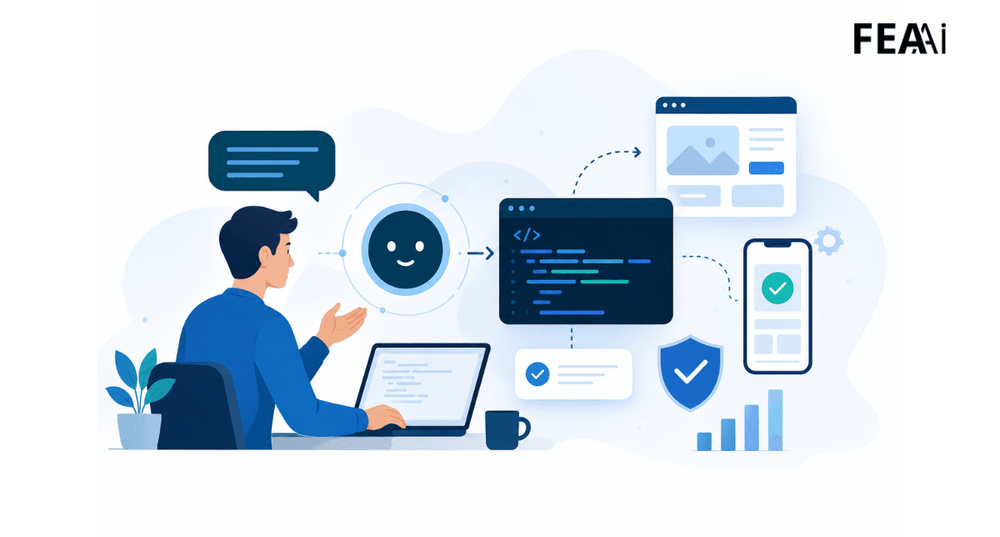
Vibe coding is making software creation faster and more accessible than ever, but speed alone does not guarantee reliability. As AI takes over more of the coding process, the real challenge shifts toward defining requirements clearly, validating results, and controlling risk. The future of development may depend less on who can write code fastest and more on who can verify it most effectively.
Vibe coding is one of the most exciting new directions in AI-based software development. Its essence is that the developer does not write code line by line, but prompts the AI in natural language, describing what they want to create. The model then generates, modifies, and fixes the code, while the developer guides the process through feedback.
At first, it may sound as if programming is becoming a kind of conversation. However, the real change is that the focus of development work is shifting: coding itself may require less time, while accurately defining goals, validating the result, and interpreting errors become increasingly important.
Software development without developers
More and more users are starting to build their own applications with AI-supported software, even though they have never written code before. These are not world-changing startups, but digital answers to everyday problems: restaurant picker web apps, personal planners, or small family applications.
This is why terms such as “micro app” or “personal app” are becoming more common. The user does not necessarily want to launch a product on the market. They simply have a problem for which there is no ready-made solution, so they create their own with the help of AI. This fundamentally changes how we think about software. Not every application has to be built for the masses. Sometimes it is enough if it solves the problem of one person or a narrow user group precisely.
Real-life examples
The following examples clearly show the diversity of this trend. TechCrunch presented a web application called Where2Eat, created by a user without a traditional developer background to help their friends find restaurants that matched everyone’s preferences. A simple, real problem with a clearly defined goal allowed AI to quickly create a working application.
The trend has also appeared on the business side. According to reports, an AI content creation tool called Stanley was built in two weeks using a vibe coding approach and acquired paying customers within a short period of time. In this case, the result was already a validated, revenue-generating digital product.
Why does it change the logic of development?
Vibe coding significantly lowers the barrier to entry. An idea can become a working prototype faster, and a business problem can turn into a testable solution almost immediately. It is not only useful for developers, but also for professionals who understand the problem but would not be able to program a complete system on their own.
Previously, creating working applications without knowledge of programming languages was impossible. Now the question is who can define requirements precisely, give useful feedback to the AI, and recognize in time when a quickly created solution only appears to work well.
The price of speed
The greatest promise of vibe coding is speed. However, this is also its greatest risk. AI can write code in moments, but it does not necessarily understand a company’s business logic, the connections between existing systems, or long-term maintainability requirements.
For a prototype, this may be an acceptable risk. In a live enterprise system, however, it matters greatly whether the code is secure, scalable, testable, and transparent. This is why, alongside a faster development pace, solutions that help keep quality under control are becoming increasingly important. One example is an AI-supported test management tool which can help not only with organizing testing processes, but also with identifying higher-risk changes. Vibe coding does not eliminate developer expertise; it transforms its role.
Why does QA become even more important?
The faster code is created, the greater the need for conscious quality assurance. In the case of AI-generated solutions, it is especially important to verify whether they work properly in different situations, under load, in edge cases, and as part of the existing system. The role of QA management therefore does not decrease. On the contrary, it becomes more valuable.
Where does TestNavigator fit in?
TestNavigator builds a control layer around fast development processes. One of the biggest challenges of vibe coding is that the pace of development can move ahead of testing. If AI modifies the codebase from multiple directions, it is not always clear which changes carry a higher risk of errors. With change- and risk-based test case prioritization, TestNavigator helps QA teams make decisions based on objective metrics rather than intuition.
This is especially important for enterprise software, where a quickly generated solution is connected to existing systems, data flows, and business operations. In this context, it is not enough for a new feature to appear to work at first glance. It must also be checked whether it causes regression errors or weakens system stability. In this way, TestNavigator does not slow down vibe coding, but places it within a safer and more controlled framework.
Is the future already here?
AI is reshaping the software industry at a fundamental level within a short period of time, but this does not make established quality assurance processes unnecessary. Quite the opposite: without proper control, we cannot be sure that these solutions can be released safely and used reliably.
If the goal is not only fast development, but also stable and verifiable operation, testing must keep pace with the new development speed. An AI-supported test management tool, such as TestNavigator, can provide support in this process.
- AI-supported custom software development
- QA management
- enterprise QA platform