
Tech giants are already moving toward AI-first – but how can QA management keep up?
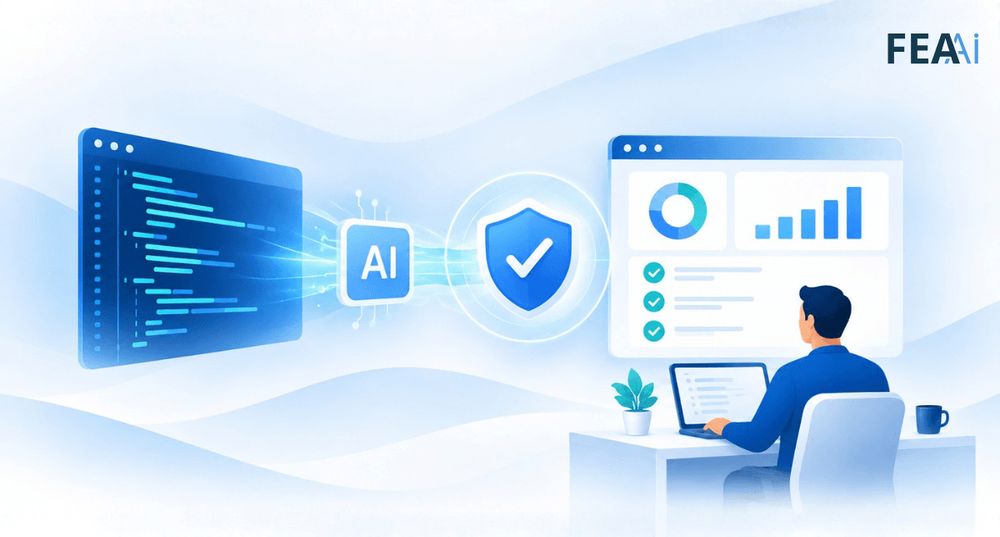
AI is reshaping software development by accelerating code generation and shortening release cycles. As more code is produced with AI assistance, quality assurance must adapt to a faster and more complex development environment. The focus is shifting from traditional testing toward risk-based, data-driven QA management that supports better decisions about software quality. In an AI-first development model, keeping pace increasingly depends on how effectively organizations can identify and manage quality risks.
In recent years, AI has become one of the main drivers of software development in a growing number of organizations. At first glance, the benefits are obvious: faster development, more useful features, and shorter delivery cycles. However, there is another consequence that is less visible but just as important: the role of quality assurance is changing fundamentally.
Google’s example: AI is taking over code generation
In early 2026, Google reported that a significant share of new code produced in its internal development projects was already being generated by Gemini, Google’s AI model. In some projects, this share can reach as high as 70–75%. This is particularly striking because, based on figures from late 2024, AI was responsible for only around a quarter of newly written code.
This means development speed has increased dramatically. At the same time, the volume of code being produced is also growing rapidly. The role of developers is changing as well, with more attention shifting toward reviewing, supervising, and refining AI-generated code. This directly affects testing processes, as teams need to test and validate more code in less time.
Microsoft’s data: faster development brings new challenges
Measurements related to Microsoft and GitHub Copilot suggest that developers can work 30–55% faster with AI assistance. This increase is not only about efficiency. Faster development also leads to more releases, more changes, and potentially more defects.
Development has accelerated, but quality assurance cannot automatically keep pace with this faster cycle. The use of AI also does not guarantee better software quality on its own, nor does it eliminate the need for professional review and validation.
According to Microsoft, the market is clearly moving toward an “AI-first” model, where artificial intelligence becomes embedded throughout the software development lifecycle. This is not a temporary trend, but a long-term direction that is likely to strengthen further in the coming years.
Stack Overflow and McKinsey: AI is becoming part of everyday development
According to the Stack Overflow 2025 survey, AI has become part of everyday development work. More than 70% of respondents already use AI tools or plan to use them in their work. This means software development is increasingly becoming a collaboration between humans and AI, where producing code is no longer necessarily the biggest challenge.
At the same time, this creates new problems. As the share of AI-generated code grows, quality control becomes increasingly critical. Development is getting faster, but it is also becoming more important to understand exactly what is being introduced into the system and what software risks these changes may create.
McKinsey’s research places the role of AI in a broader business context. The report suggests that generative AI is not simply another technology tool, but one of the most significant drivers of productivity growth in the coming years.
In software engineering, the research estimates an average productivity increase of 20–45%, particularly in areas such as code generation, documentation, and testing support. McKinsey also highlights these areas as some of the fastest-scaling AI use cases.
How the testing process is changing
All of these trends point in the same direction: development is getting faster, the volume of code is increasing, and managing defects and risks is becoming more complex.
In this environment, testing is no longer simply about finding bugs. Its role is increasingly to provide a clear, data-driven view of the current state of the software.
The focus is gradually shifting:
- from aiming for comprehensive coverage to a risk-based approach,
- from subjective judgment to measurable, data-driven decision support,
- from testing as a mandatory process to testing as a source of business insight.
The real challenge is decision-making
The real challenge for companies is whether quality assurance and decision-making can keep pace with the speed of development. The competitive advantage of the future will not come from faster development alone. It will increasingly depend on who can make better-informed decisions about software quality and risk.
- AI-supported custom software development
- QA management
- AI