
It no longer just answers, it acts too: the age of AI agents has arrived
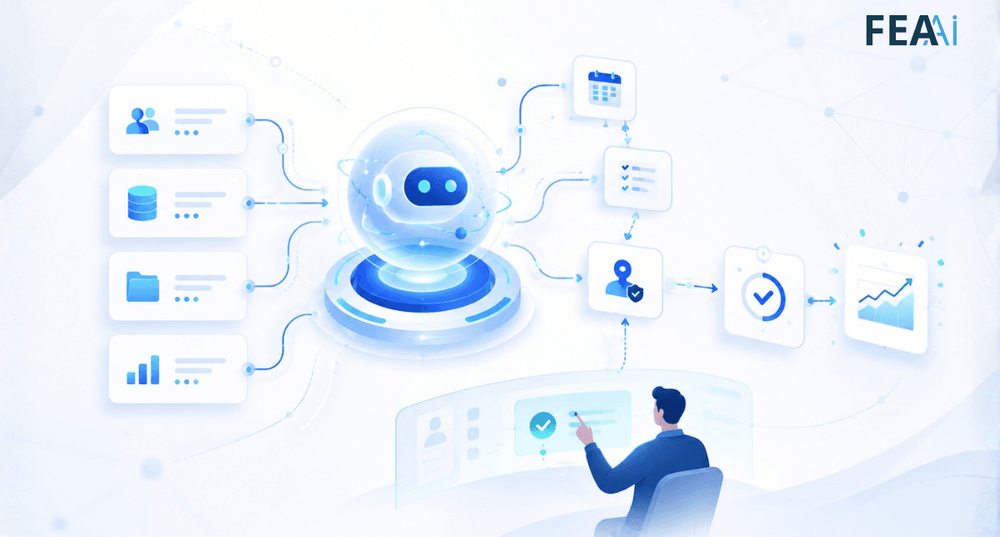
AI agents are changing the way companies think about artificial intelligence: instead of simply answering questions, they can increasingly carry out complete tasks and workflows. By connecting to existing business systems, they can retrieve data, prepare actions, and support day-to-day operations with growing autonomy. This shift also brings new requirements around integration, access control, supervision, and human approval. The article explores what agent-based AI means in practice and why it is becoming an increasingly important part of enterprise software development.
In recent years, AI use in many companies has followed roughly the same pattern: we ask a question, provide some information, and wait for an answer. AI writes text, summarizes documents, analyzes data, or generates ideas. But this way of working is increasingly becoming just the first step. In the next phase, we will no longer simply expect AI to provide answers. We will assign it concrete tasks to carry out.
The topic of this article was partly inspired by our experience with an ongoing project, where we are seeing first-hand how agent-based AI is becoming an increasingly integral part of everyday business operations. We therefore want to bring readers closer to this field and explain what this shift means in an enterprise environment.
What is the difference between a chatbot and an AI agent?
In 2026, AI agents have also moved to the forefront of development efforts by major technology companies. OpenAI, Microsoft, and Google are all building enterprise solutions in which AI does more than provide information. These systems can execute multi-step workflows, connect to business applications, and use different tools to complete tasks.
A traditional chatbot is fundamentally reactive. For example, we might ask which customers placed an order in the past month and receive an answer. A properly integrated AI agent can go further: it can retrieve the relevant data from a business system, identify the customers concerned, prepare a summary, generate a report, and even prepare the next action.
The key difference is therefore between answering a question and executing a task. Based on a defined objective, an AI agent can perform several consecutive steps, using different data sources or software systems and automating parts of a workflow in the process. According to Microsoft, workflows with clear rules, recurring coordination tasks, and well-defined outcomes are among the most obvious enterprise use cases for agentic AI-powered tools.
AI is moving closer to business processes
This shift can significantly change how companies think about AI adoption. Deploying a general-purpose chatbot may require little more than providing access to an application. A true enterprise AI agent, however, needs to understand how the organization operates.
It may need to connect to ERP, CRM, document management, or other internal systems, access the data required to perform its tasks, and operate within precisely defined boundaries regarding which actions it is allowed to take independently. As a result, building an effective AI-supported enterprise software solution often means more than introducing an off-the-shelf AI tool. It means creating a system tailored to the company’s processes, data, and existing IT environment.
This is where custom software development becomes particularly important. The real business value of AI is often created through effective integration with existing systems rather than through the AI model itself.
With an enterprise agent, the question is therefore not only what it can do, but also which data it can access, which actions it is authorized to perform, and when human approval is required. AI adoption is consequently becoming less of a standalone technology project and more of a software integration and process development challenge.
More autonomy requires more control
The more tasks AI can perform independently, the more important it becomes to define clear boundaries. Not every business decision should be fully automated. In some processes, an agent may be allowed to carry out an action independently. In others, it may only prepare a decision that must then be approved by an employee.
This requires proper access management, auditability, testing, data governance, and continuous supervision.
The next major step in enterprise AI will therefore probably not be simply getting more employees to use chatbots. Instead, AI will gradually become embedded in existing business processes and software systems. At the same time, custom software development will increasingly be designed from the outset with AI capabilities and agent-based workflows in mind.
- AI-supported custom software development
- QA management
- enterprise QA platform