
AI in testing: Speed or false sense of security?
Artificial intelligence is no longer just revolutionizing coding but also transforming software testing. More and more tools promise to generate automated tests within minutes – tests that previously could take hours or even days to create.
At first glance, this is a huge advantage: testers can react more quickly to changes, regression coverage increases, and development cycles accelerate. It’s no surprise that many companies are already experimenting with these solutions. But the key question remains: how reliable are these AI-generated tests in practice?
Artificial intelligence is no longer just revolutionizing coding but also transforming software testing. More and more tools promise to generate automated tests within minutes – tests that previously could take hours or even days to create.
At first glance, this is a huge advantage: testers can react more quickly to changes, regression coverage increases, and development cycles accelerate. It’s no surprise that many companies are already experimenting with these solutions. But the key question remains: how reliable are these AI-generated tests in practice?
Misleading AI tests?
Several studies have shown that AI-generated tests are often superficial: they tend to verify the most common code paths but ignore the critical “edge cases” that may hide serious bugs.
For example, Schäfer et al. (2023) conducted an empirical study and found that unit tests written by ChatGPT often looked correct but failed to uncover significant defects. As the authors noted:
“LLM-generated tests often show high coverage, but their fault-detection capability is weak.”
Similarly, Yuan et al. (2023) highlighted that many ChatGPT-generated tests are redundant and provide little real added value to existing test suites. According to their study, nearly 30% of AI-generated tests repeated the same logic as human-written tests.
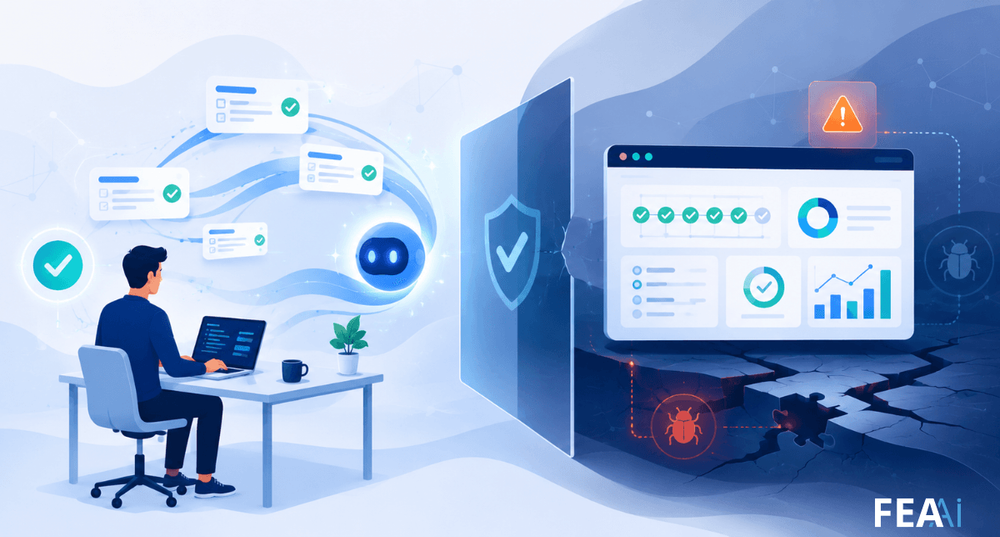
This is where the danger lies: the pipeline shows a green status, while critical bugs remain hidden. This creates a false sense of security – not only for testers and developers but also for management and decision-makers.
Speed vs. quality: The trade-off
AI can indeed speed up test generation, but this often comes at the cost of quality. The real question is not whether AI can write tests, but whether those tests can actually detect bugs.
As Mohammad Baqar and colleagues emphasized in their 2024 research:
“AI can quickly generate a large number of tests, but without proper evaluation and validation, overconfidence in the test suite can easily develop.”
In other words, while AI speeds up test generation, speed alone does not equal value. Real added value only appears when AI-generated tests are complemented with careful validation, test prioritization, and continuous quality assurance. Without this, AI produces nothing more than “noise” in the QA process – while real bugs continue to slip through.
How to use AI in testing wisely?
Don’t trust blindly – AI-generated tests must always be validated using both manual and automated techniques. Human + AI collaboration – AI is useful for repetitive, “happy path” tests, but critical and complex scenarios still require experienced testers. Data-driven monitoring – don’t just measure coverage, also track how many actual bugs the AI-generated test suite is able to detect. Use professional AI tool:
A perfect companion here can be Testnavigator, a modern, intelligent, AI-assisted testing platform designed to eliminate false confidence in QA processes. The system doesn’t just measure code coverage at the method and branch level; it also intelligently detects changes, ensuring that critical areas always receive attention during testing. The built-in TestAdvisor algorithm prioritizes test cases so that the team can focus on the riskiest areas first.
As a result, testing becomes faster, more focused, and – most importantly – more reliable: unnecessary executions are minimized, and gaps are uncovered in time. TestNavigator is therefore an ideal solution for organizations that want to combine the advantages of AI-driven testing with safe and transparent QA processes.
How AI is changing the role of testers
In their study “A Secondary Study on AI Adoption in Software Testing” (2024), Katja Karhu and colleagues found that while AI adoption in software testing is still in its early stages, its impact on testers’ work and QA processes is already noticeable. The authors highlight that AI currently functions primarily as an assistant and cannot fully replace human expertise:
“AI is currently a complement to the testing process, supporting but not replacing human expertise.”
The new role of testers
This trend is gradually reshaping the role of software testers. Instead of manual test writing, the focus is shifting toward the oversight, evaluation, and refinement of AI-generated tests. Future QA professionals will play a key role in ensuring that AI-created test suites contribute to bug detection rather than providing a false sense of security. This elevates the profession: testers become strategic partners in the development lifecycle.
Not a replacement, but a reinforcement AI is undeniably revolutionizing testing: it makes the work faster, more convenient, and more productive. But it cannot replace the careful, critical mindset of skilled software testers.
The winners of the future will be those teams that recognize: AI will not replace testing, but integrating it into the testing process is essential – provided it is combined with human expertise, conscious prioritization, and robust QA practices.