
After AI-first development, is AI-first QA management next?
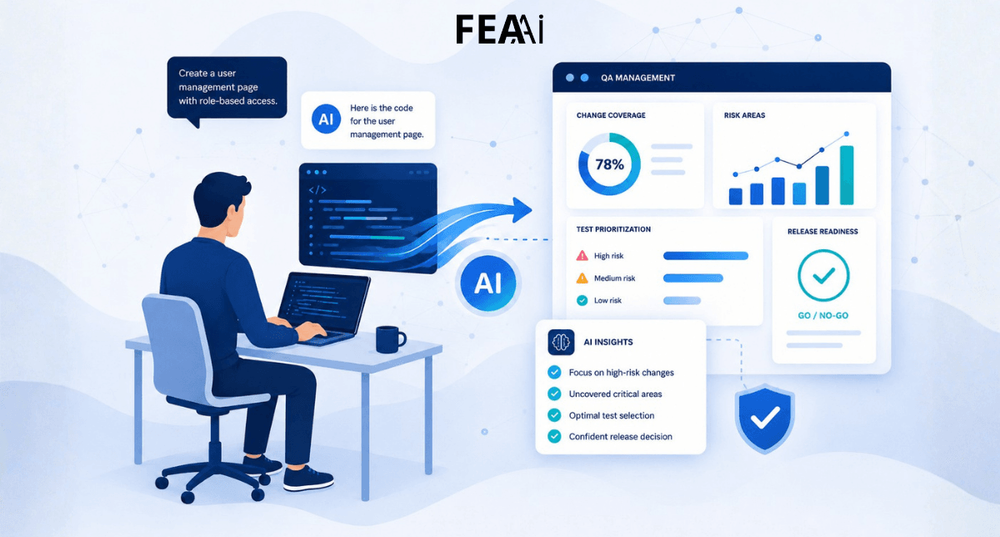
AI is accelerating software development, but faster code generation also increases the pressure on quality assurance. As development cycles shorten, QA teams need more than additional tests: they need better data to understand what changed, where the risks are, and whether a release is truly ready. AI-first QA is therefore less about replacing testers and more about enabling faster, more targeted, and data-driven decisions.
AI is making software development faster, but at the same time it is placing greater pressure on QA. The question is no longer how to test more, but how to use data to determine which areas deserve the most attention. AI can support risk-based test prioritization, help teams interpret coverage data, and contribute to more informed release decisions. In this sense, AI-first QA is not about replacing testers, but about creating a faster, more targeted, and data-driven approach to quality assurance.
AI is no longer an isolated experimental technology in software development. It is increasingly becoming a fundamental part of everyday development workflows. More and more teams use AI for writing code, refactoring, documentation, and even completing entire development tasks. This accelerates development, but it also raises an important question: if code can be produced faster, how can quality assurance keep pace?
Faster development does not automatically mean faster delivery
According to Google DORA research, generative AI primarily amplifies the way an organization already operates. In a well-designed development process, it can provide significant benefits. However, when feedback mechanisms are weak, problems can also emerge and spread more quickly. DORA data suggests that increased AI adoption does not automatically improve software delivery performance, making fast and reliable feedback loops increasingly important.
This represents a significant change for QA management. If more code and more changes are produced within the same amount of time, testing teams cannot simply respond by testing more. Instead, they need better ways to determine where their attention should be focused.
AI is already writing tests
The next step is a logical one: artificial intelligence can support not only software development, but testing as well. In a 2026 study examining open-source projects, AI agents were responsible for 16.4% of commits that added tests. Across several projects, AI-generated tests achieved test coverage comparable to, and in some cases higher than, tests written by human developers.
However, this does not mean that testing can simply be handed over to AI. Another 2026 study analyzing more than 200,000 test files found that AI-generated tests were effective at covering certain edge cases, but also showed a higher risk of flakiness.
AI-first QA therefore does not mean replacing testers with artificial intelligence. In practice, AI can support risk-based test prioritization and assist with the creation, selection, and evaluation of test cases based on the available data.
We do not need more tests, but better decisions
In an AI-first development environment, QA needs to answer three questions quickly: what has changed, what needs to be tested because of those changes, and has enough testing been completed for the release?
Simply knowing how many test cases have passed provides limited information. It is more important to understand which recent changes have actually been verified and where uncovered areas still remain.
TestNavigator approaches this challenge through objective metrics. The platform connects test cases, test execution results, code coverage measurements, and the changes introduced in a specific release in one place.
Change coverage plays a particularly important role. It shows how much of the code modified during recent development has actually been covered by executed tests. This allows QA teams to look beyond the overall coverage level of the entire system and focus specifically on the areas of the current release that may carry greater risk.
TestNavigator also makes the status of testing visible at the release level. Exit criteria can be defined for test cycles, including required overall coverage, change coverage, and the proportion of test cases that must be executed. As a result, Go/No-Go decisions rely less on intuition or the manual comparison of multiple reports and more on objective, measurable data.
As AI produces code at an increasing pace, this type of visibility becomes particularly important. The goal is not simply for QA teams to work faster. The real objective is to maintain control over what has actually been tested, where risks remain, and whether the software is ready for release despite the increasing speed of development.
AI-first QA is really data-driven QA
In the coming years, the main question will probably not be whether a QA team uses artificial intelligence. The more important question will be whether the team can measure the actual outcome of testing while development continues to accelerate.
AI can generate increasing amounts of both code and tests, but this does not automatically make a release safer. Teams still need measurable feedback that shows what has actually been tested, what has been missed, and how much risk is associated with deployment.
In this sense, AI-first QA means faster, more targeted, and more data-driven quality assurance.
- QA management
- QA governance
- management-level QA insights